Counterbalancing
Modeling random assignment, block ordering, and counterbalanced designs
Random assignment is a control-flow operation: the participant goes down one path rather than another, by chance. In Studyflow, this maps to the RandomGateway element. This guide covers the three patterns you will use most often.
Random assignment to groups
The simplest case: every participant is randomly assigned to one of two (or more) conditions.
Drop a RandomGateway after the demographics block. Add an outgoing sequence flow for each condition. The inspector lets you set the probability on each branch (default: equal). The runtime evaluates the probabilities at execution time and routes the participant down exactly one branch.
A simple two-group random assignment diagram should live at docs/assets/img/guides/random-assignment.svg. The element catalog already has random_gateway_pattern.svg which illustrates the basic shape.
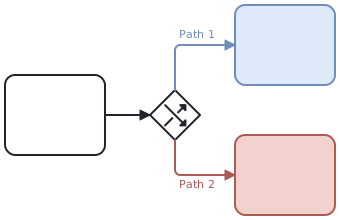
For balanced (not just random) assignment, add a condition attribute on the gateway that references a counter or stratification variable from earlier in the flow. The runtime will assign so as to keep the groups balanced rather than independently random per participant.
Block-level counterbalancing
When you have several task blocks (say A, B, C) and want every participant to do all of them, but in a randomized order, you have two options:
Option 1: Random gateway over fixed orderings. Enumerate the orderings you care about (ABC, ACB, BAC, …) as separate sub-flows downstream of a RandomGateway. Each branch contains the blocks in one specific order. This is explicit and easy to read but verbose when you have many blocks.
Option 2: Parallel gateway with random sequencing. Use a parallel gateway and annotate each block with a randomOrder attribute. The runtime computes a permutation per participant. This is concise but pushes the randomization into the runtime; reviewers may want Option 1 for clarity.
For 2 or 3 blocks, prefer Option 1 – the diagram is the spec. For 4+ blocks, Option 2 is the only sane choice.
Stratified randomization
Stratification means: keep the random assignment balanced within subgroups. For example, balance gender within each treatment arm.
The pattern is: branch first on the stratification variable (an Exclusive gateway on gender, say), then run the RandomGateway independently inside each branch. Each RandomGateway keeps its own counter. The diagram makes it visually obvious that randomization is happening per-stratum.
Counterbalancing across trials
For trial-level counterbalancing within a single task (e.g., congruent vs incongruent Stroop trials in random order), keep the counterbalancing inside the task rather than expressing it in the diagram. Studyflow diagrams describe study-level structure; trial-level randomization is a parameter on the CognitiveTask activity. See the Cognitive tasks example for trial-level structure.